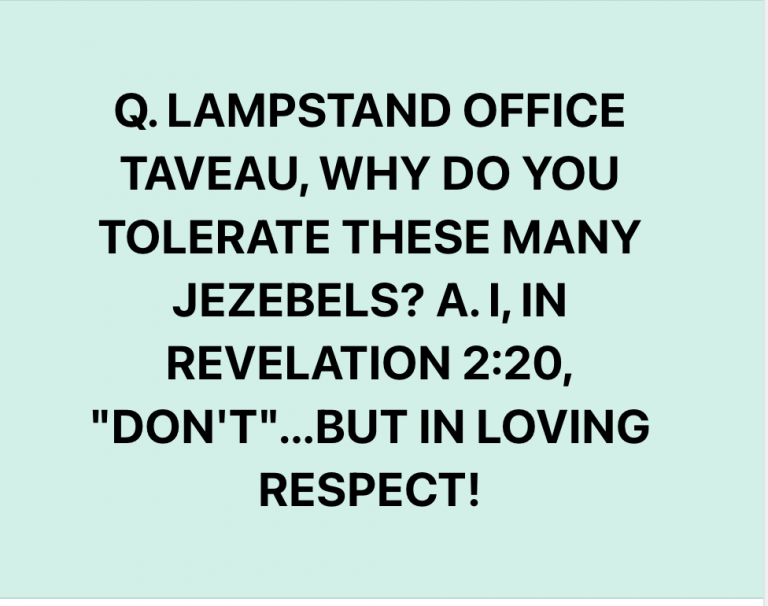
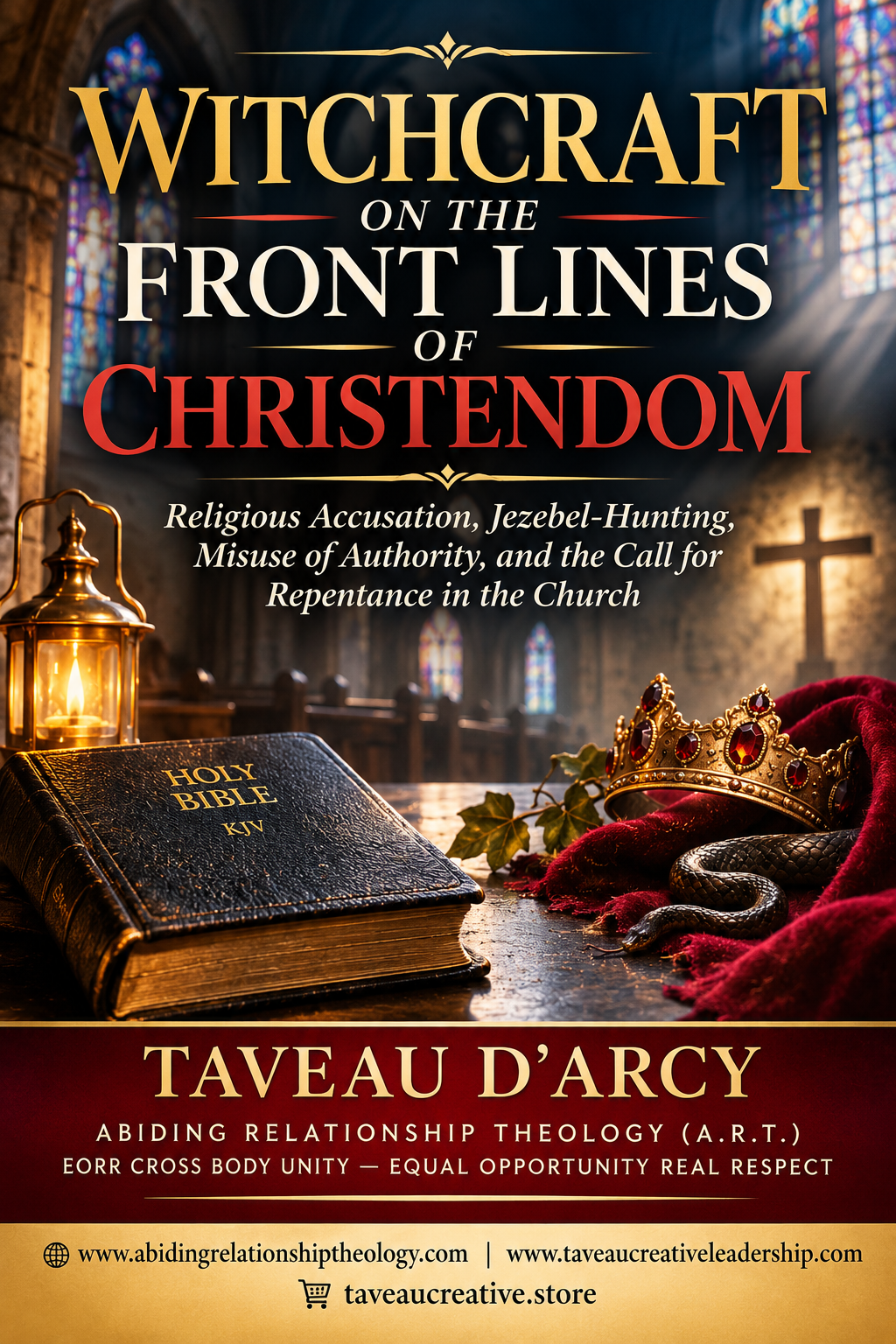
Q. WITCHCRAFT ON THE FRONT LINES OF CHRISTIANDOM?
The Complete 6 article series in 125-130 page PDF AVAILABLE on Nov 2 www.taveaucreative.store
Below is forward which Taveau published on taveau.substack.com Nov 1
WITCHCRAFT ON THE FRONT LINES OF CHRISTENDOM: WHO IS WATCHING THE WATCHMEN?
When prophetic discernment becomes religious suspicion, and the wounded worshipper is mistaken for the enemy
By Taveau D’Arcy | Abiding Relationship Theology (A.R.T.)
There is something that has concerned me for many years as I have visited and studied different Christian ministries, particularly within certain apostolic, prophetic, and charismatic movements. I have observed an extraordinary amount of attention devoted to identifying Jezebel, witchcraft, rebellious spirits, and supposedly dangerous people within the Church.
Yet I have often wondered whether some of those who are most occupied with detecting hidden spiritual enemies have taken sufficient time to examine their own conduct toward the people they claim to serve.
I believe in the Holy Spirit, the gifts of the Spirit, and the biblical responsibility to discern genuine wrongdoing. I also believe that spiritual discernment must be exercised according to Scripture, with humility, truthfulness, and accountability.
During decades of studying different Christian ministry cultures, I encountered some wonderful, honorable people. I also encountered situations where unfamiliar individuals appeared to be examined from a distance, treated with suspicion, or classified according to religious expectations that had little to do with their actual conduct.
Some of these experiences occurred in environments where the worship was deeply moving. That made the contrast especially troubling.
I was often attending because I wanted to worship the Lord and recover perspective during a difficult period of my private life.
At the time, I was raising two children while enduring prolonged harsh treatment, verbal abuse, rage outbursts, and painful silent treatment within a relationship. I continued functioning, fulfilling responsibilities, and maintaining my personal walk with the Lord, but I was becoming emotionally weary.
I was strong and enduring, yet deeply in need of God’s help.
Jesus said:
Matthew 5:3 KJV
“Blessed are the poor in spirit: for theirs is the kingdom of heaven.”
I now recognize how personally meaningful that Scripture was during those years. I was not entering Christian gatherings to challenge somebody’s authority or obtain a position in another person’s ministry. Deep worship helped me bring my private suffering before the Lord.
The people observing me did not know what I was enduring.
That is why I have come to identify so strongly with Hannah.
WHEN ELI MISJUDGED HANNAH
In 1 Samuel 1, Hannah arrived at the house of the Lord after years of grief and provocation. She was praying out of the bitterness of her soul when Eli the priest observed her lips moving without hearing her voice.
1 Samuel 1:13–14 KJV
“Now Hannah, she spake in her heart; only her lips moved, but her voice was not heard: therefore Eli thought she had been drunken.
And Eli said unto her, How long wilt thou be drunken? put away thy wine from thee.”
Eli had observed something unusual, but his interpretation was wrong.
Hannah respectfully corrected him, explaining that she was a woman of a sorrowful spirit who had poured out her soul before the Lord.
The priest had mistaken a suffering worshipper for somebody behaving improperly.
I believe this account deserves renewed attention within contemporary Christian leadership, especially wherever claims of supernatural discernment have become substitutes for ordinary communication and the responsible examination of facts.
A strong personality does not establish rebellion. An independent woman is not automatically a Jezebel. A person who does not belong to a particular ministry organization has not thereby rejected the authority of Jesus Christ.
The visitor may be carrying private suffering that nobody in the congregation knows anything about.
And the person who claims to discern something about that visitor may be mistaken.
THE PROBLEM WITH JEZEBEL-HUNTING
I have also questioned the way certain Christian environments teach about Jezebel.
The Old Testament account certainly identifies Jezebel’s wicked conduct. But what about Ahab?
1 Kings 16:30–31 KJV describes Ahab doing evil in the sight of the Lord, marrying Jezebel, and serving and worshipping Baal.
Ahab was responsible for his own decisions. His father Omri had already been condemned for his evil conduct.
The biblical account does not support treating Ahab as an entirely innocent man whose only problem was an unusually powerful wife.
Then consider Christ’s message to the church at Thyatira.
Revelation 2:20 KJV
“Notwithstanding I have a few things against thee, because thou sufferest that woman Jezebel, which calleth herself a prophetess, to teach and to seduce my servants to commit fornication, and to eat things sacrificed unto idols.”
Notice that the Lord addressed the church concerning its tolerance of wrongdoing. The woman identified as Jezebel was also held accountable in the surrounding passage, but the responsibility of those permitting her influence was not overlooked.
That is an important governing lesson.
If a ministry leader knows that somebody is abusing influence, teaching serious error, or mistreating people, the leader has a responsibility to address the actual conduct.
Why, then, have some religious cultures become so occupied with identifying supposed Jezebels among unfamiliar women while giving insufficient attention to wrongdoing within their own established leadership circles?
I believe that question deserves serious examination.
WHEN DISCERNMENT RESEMBLES RELIGIOUS SURVEILLANCE
Another concern involves the fascination with knowing hidden things about other people.
The Bible records extraordinary revelation through the prophet Elisha. According to 2 Kings 6:12, Elisha knew the words spoken by the Syrian king in his bedchamber.
That was a particular biblical event involving the protection of Israel during a military threat. It does not establish a general right for modern religious leaders to investigate strangers’ private lives or present their impressions as unquestionable revelation.
I have encountered prophetic environments where unusual claims of spiritual perception seemed to encourage personal scrutiny, unsupported assumptions, and what I describe as psychic-style prophetic practices.
I am particularly concerned when somebody’s private impression becomes the basis for labeling another Christian without establishing the facts.
KEY POINT:
The New Testament expressly instructs that prophetic speech be evaluated.
1 Corinthians 14:29 KJV
“Let the prophets speak two or three, and let the other judge.”
A claimed revelation should not place its speaker beyond accountability.
I have used the expression spectral evidence to describe, by analogy, religious accusations based upon supposed unseen information that the accused person has no meaningful opportunity to examine or answer.
That is a dangerous way to govern people.
If a person has actually committed wrongdoing, identify the conduct and address it responsibly. Where appropriate, follow the principles of private correction and witnesses described in Matthew 18:15–16. Serious abuse or criminal misconduct requires appropriate protection and civil reporting, rather than concealment behind religious procedures.
Paul also instructs those who are spiritual to restore a person overtaken in a fault in the spirit of meekness, according to Galatians 6:1.
These are serious responsibilities for people who claim apostolic or prophetic authority.
THE CHURCH MUST EXAMINE ITS OWN CONDUCT
Paul warned Timothy about the character of people in perilous times.
In 2 Timothy 3:1–5 KJV, he describes people who are proud, fierce, false accusers, and lovers of their own selves, including those who possess a form of godliness while denying its power.
These warnings must not be applied exclusively to people outside the Church.
Religious titles, impressive worship, financial success, and claims of supernatural revelation do not exempt Christian leaders from examining their own behavior.
I believe some ministries need to reconsider the manner in which they exercise authority, receive unfamiliar people, handle disagreements, and respond to legitimate questions.
The wisdom of God provides a standard.
James 3:17 KJV
“But the wisdom that is from above is first pure, then peaceable, gentle, and easy to be intreated, full of mercy and good fruits, without partiality, and without hypocrisy.”
I have made this Scripture central to my teaching on Abiding Relationship Theology because the Christian life must affect our actual relationships.
A person can be firm in doctrine while remaining respectful of another human being. A pastor can exercise legitimate authority without treating an independent visitor as a threat. A prophet can believe in spiritual revelation while acknowledging the possibility of misunderstanding what has been perceived.
This is also why I teach Equal Opportunity REAL Respect for every human office.
Respect does not require endorsement of wrongdoing. It does require that we treat other people with the dignity and fairness appropriate to those who profess to follow Jesus Christ.
I have often said that if somebody believes there is a problem with me, the reasonable thing is to ask me directly. I am willing to discuss legitimate concerns, and I believe Christian leaders should be willing to do the same.
The Lord Himself said:
Isaiah 1:18 KJV
“Come now, and let us reason together, saith the LORD: though your sins be as scarlet, they shall be as white as snow; though they be red like crimson, they shall be as wool.”
I believe the Church needs to recover the willingness to reason truthfully, correct actual wrongdoing, and reconsider assumptions that have injured people.There are wounded worshippers entering Christian gatherings today who may appear confident, independent, or unusually strong. Their outward manner does not reveal what they have endured privately.
Before assigning a spiritual label to somebody you do not know, consider Hannah.
And before looking for another Jezebel in the congregation, consider the governing responsibility of Ahab and the warning to Thyatira.
I believe the Church must be willing to repent of its own harmful practices before expecting the surrounding world to receive its correction.
We are not replacing revival with relationships. We are allowing revival to reach the relationships.
Taveau D’Arcy
Abiding Relationship Theology (A.R.T.)
EORR Cross Body Unity — Equal Opportunity REAL Respect
Adapted from the six-part teaching series, “Witchcraft on the Front Lines of Christendom.”
(C)2026 Taveau D’Arcy All copyrights reserved, In conjunction with AI.