
PART 1 OF 3 FAITH ROOTS RESEARCH …..METHODIST FOUNDER JOHN WESLEY
This was first posted Nov 18, 2025
ARTICLE 1 FAITH ROOTS RESEARCH: JOHN WESLEY
ASKING: DID METHODIST FOUNDER JOHN WESLEY PREACH A TRUE GOSPEL OR AN ACCURSED ONE?
(C) 2025 Taveau D’Arcy — All Rights Reserved in Conjunction with AI
FIRST PART BIO AS THE INTRODUCTION
I. JOHN WESLEY HIMSELF — The Historic Man
Wesley’s own beliefs (from his sermons, journals, letters, societies):
Wesley was:
-
A Bible-only preacher (“I am a man of one Book.”)
-
A holiness man (Hebrews 12:14)
-
A repentance + living faith preacher
-
A new birth preacher (John 3)
-
A First-Church / Acts-style small group discipler
-
A servant-leader, not a bishop-with-power
-
A fruit-tester (Matt. 7:15–20)
-
A man of compassion for the poor
-
A man who rejected:
-
cold institutional religion
-
dead formalism
-
authoritarian clergy
-
theological speculation
-
sin-tolerant Christianity
-
“once saved always saved”
-
high-control church government
-
Wesley’s CORE GOSPEL
“Salvation by grace through faith which produces holiness of heart and life.”
This is his actual doctrine.
Wesley’s CORE FRUIT (Biblical fruit)
-
Repentance
-
Assurance of salvation
-
Holiness (heart purity)
-
Love of neighbor
-
Acts-style community
-
Evangelism
-
Scriptural lifestyle
-
Practical obedience
-
Social compassion
-
Non-hierarchical leadership
-
Fellowship groups (class meetings)
This is the real Wesley.
II. MODERN “WESLEYAN / METHODIST / HOLINESS / PENTECOSTAL” STREAMS
Modern groups bearing his name range from:
-
Biblical holiness movements
(Church of the Nazarene, Wesleyan Church, Holiness churches) -
Mainline Methodism
(very wide theologically) -
Pentecostal denominations that grew out of Wesleyan holiness roots
(Church of God, Assemblies of God) -
Liberal theological Methodists
(many reject his doctrines entirely) -
Prosperity-style groups that claim Wesley but do not resemble him at all
These groups are not doctrinally united.
They share his name, history, or institutional lineage—
but many do not share his Bible fruit.
III. WESLEY vs MODERN WESLEYANS: What Changed?
1. WESLEY WAS BIBLE-ONLY. MANY MODERN GROUPS ARE NOT.
Wesley said:
“Let me be homo unius libri — a man of one Book.”
Today, many modern heirs:
-
follow denominational tradition
-
adopt culture beliefs
-
reinterpret Scripture to match society
-
debate the authority of Scripture
-
downplay holiness
-
accept sin as identity, not temptation
This part does not match Wesley.
2. WESLEY PREACHED NEW BIRTH. MANY MODERN GROUPS PREACH MORAL NICENESS.
Wesley:
-
“Ye must be born again.”
Many modern Methodists:
-
“Be kind, be inclusive, be community focused.”
Wesley preached transformation, not niceness.
3. WESLEY PREACHED HOLINESS. MANY MODERN GROUPS TOLERATE SIN AS NORMAL.
Wesley:
-
insisted on holy living
-
taught entire sanctification (heart purity)
-
believed in victory over known, willful sin
Many modern heirs:
-
say holiness is “legalistic”
-
preach psychology over sanctification
-
teach “struggle gospel” not “victory gospel”
-
excuse immorality in leadership
This is a different gospel.
4. WESLEY WAS AN EVANGELIST. MANY MODERN GROUPS ARE INSTITUTIONAL.
Wesley:
-
preached outdoors
-
went to the poor and forgotten
-
traveled relentlessly
-
was rejected by elite clergy
-
built discipleship groups, not buildings
Many modern heirs:
-
preserve pensions and buildings
-
rely on committees
-
preach institutional unity instead of repentance
Wesley’s fruit = evangelism.
Modern fruit = administration.
5. WESLEY WAS FIRST-CHURCH in discipleship. Many heirs are passive spectators.
Wesley’s class meetings = Acts 2:42–47
-
repentance
-
accountability
-
confession
-
mutual help
-
holiness training
Many modern groups have:
-
no discipleship
-
no accountability
-
no holiness teaching
-
Sunday-only culture
That is not his fruit.
6. WESLEY was gentle in spirit. Many heirs are authoritarian or political.
He was:
-
gracious
-
humble
-
non-coercive
-
slow to judge motives
-
opposed to clergy dominance
Modern heirs include groups that:
-
use hierarchy
-
shame dissent
-
impose political ideology
-
divide people
-
act as gatekeepers
This is not Wesleyan spirit.
It is not Acts 2 spirit.
It is not Christ’s spirit.
IV. WHO BEARS THE BIBLE FRUIT?
CHRIST’S TEST (Matt. 7:15–20)
The tree is known by:
-
repentance
-
holiness
-
love
-
humility
-
obedience
-
faithfulness
-
compassion
-
self-sacrifice
-
Spirit-led community
-
Scripture fidelity
PAUL’S TEST (Gal. 5:22–23)
Fruit of Spirit:
-
love
-
joy
-
peace
-
long-suffering
-
gentleness
-
goodness
-
faith
-
meekness
-
temperance
WESLEY’S OWN FRUIT TEST
Wesley wrote:
“The gospel of Christ knows no religion but social holiness.”
(meaning holiness lived out in community, not activism)
Wesley’s real fruit is the same as:
-
Christ’s fruit
-
Acts fruit
-
Paul’s fruit
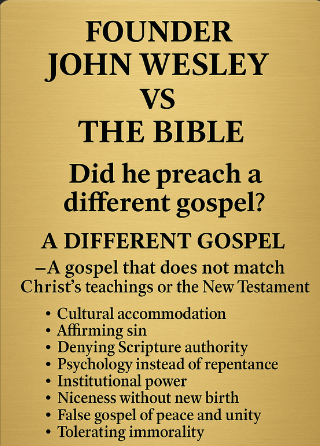
The modern fruit of many who claim his name is:
-
institutional power
-
politics
-
tolerance of immorality
-
doctrinal compromise
-
psychological self-help
-
“be nice” instead of “be holy”
That is a different gospel (Gal. 1:6–12).
V. SUMMARY: THE MAIN WESLEY FRUIT VS THE “DIFFERENT GOSPEL”
A. WESLEY’S REAL FRUIT (BIBLE-ROOTED)
-
Salvation by grace through living faith
-
New birth that transforms the heart
-
Holiness of life and spirit
-
Scriptural authority for doctrine
-
Repentance + obedience
-
Evangelism + compassion
-
Acts-style discipleship groups
-
Humble servant leadership
-
Accountability + purity
-
Power of the Holy Spirit for daily living
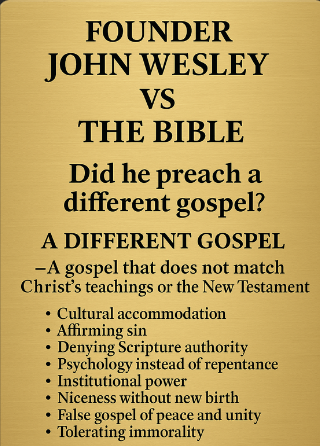
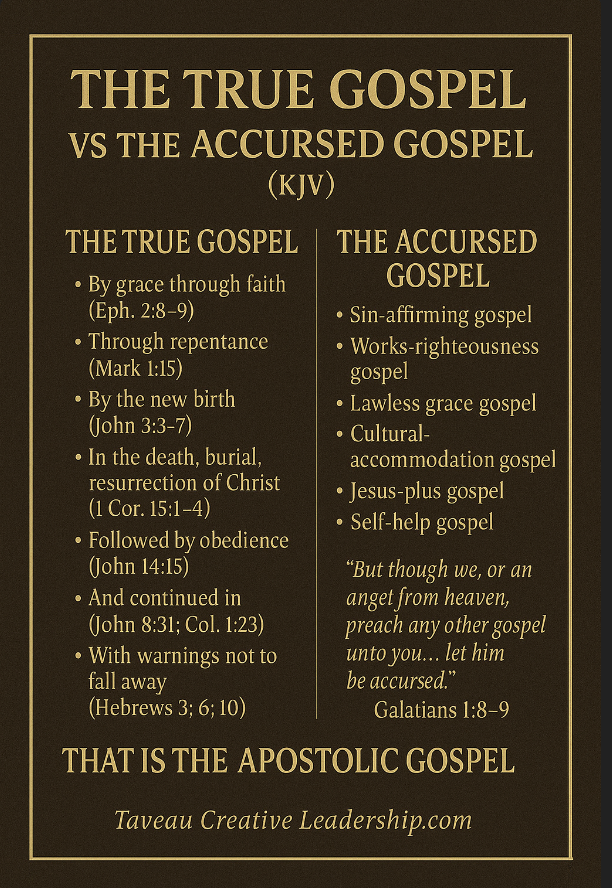
B. DIFFERENT GOSPEL (NOT WESLEY, NOT PAUL, NOT CHRIST)
-
Cultural accommodation
-
Denominational tradition over Scripture
-
Psychology over holiness
-
“You do you” instead of repentance
-
Tolerating sin as identity
-
Removing the cross from discipleship
-
Institutional control over servant leadership
-
Secular activism without spiritual transformation
-
Niceness without new birth
-
Buildings without evangelism
These are modern inventions — not Wesley, and NOT First-Church Christianity.
PART 2 OF THIS: THE MEGA BOTTOM LINE
For millions in Methodist, Wesleyan, and Holiness churches, John Wesley remains a foundational teacher. But the biblical question must be asked:
Did John Wesley preach the TRUE Gospel — or an ACCURSED gospel?
(Galatians 1:6–9)
To answer, we must define:
The TRUE Gospel
The ACCURSED Gospel
The biblical plumbline (Jesus, Paul, Hebrews, Acts)
What Wesley actually taught
Whether his doctrine contradicts or aligns with Scripture
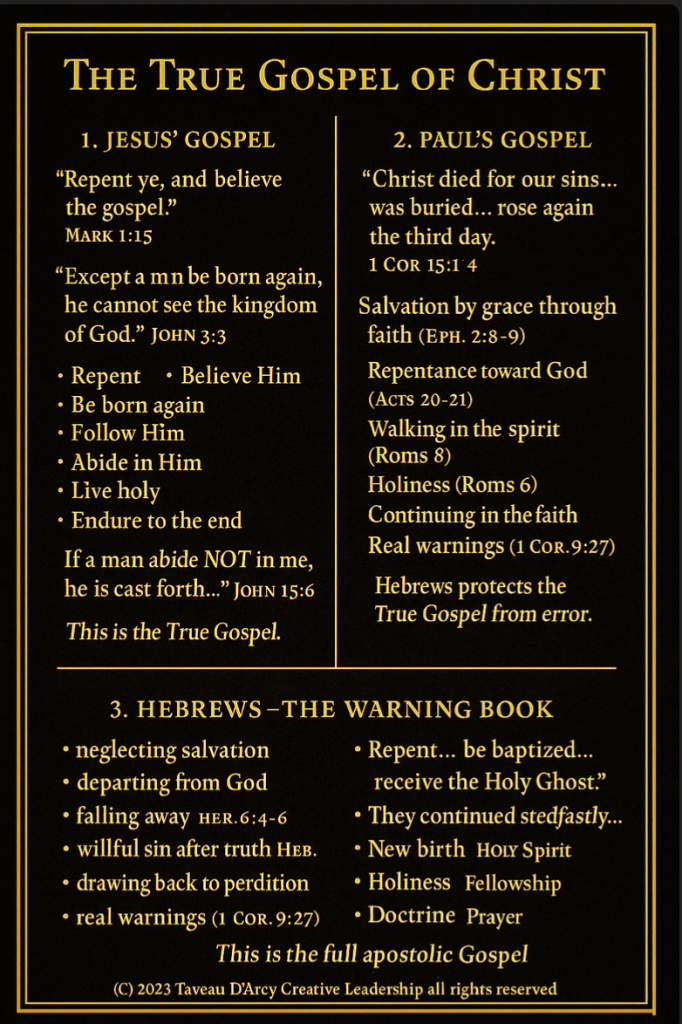
SECTION 1 — DEFINING THE TRUE GOSPEL (KJV)
1A. Jesus’ Gospel
“Repent ye, and believe the gospel.” — Mark 1:15
“Except a man be born again, he cannot see the kingdom of God.” — John 3:3
Jesus taught:
Repentance
Faith in Him
New birth
Obedience
Abiding
Holiness
Warnings against falling away
1B. Paul’s Gospel
“Christ died for our sins… was buried… and rose again the third day.”
— 1 Corinthians 15:1–4
Paul preached:
Salvation by grace through faith (Eph. 2:8–9)
Repentance (Acts 20:21)
New life in Spirit (Romans 8)
Holiness (Romans 6)
Continuing in faith (Col. 1:23)
Real warnings (1 Cor. 9:27)
1C. Hebrews
The strongest warnings in the NT:
Neglecting salvation (Heb. 2:3)
Departing from God (Heb. 3:12)
Falling away (Heb. 6:4–6)
Willful sin after truth (Heb. 10:26–27)
1D. First Church (Acts)
“Repent… be baptized… receive the Holy Ghost.” — Acts 2:38
“And they continued stedfastly…” — Acts 2:42
The TRUE Gospel includes:
Repentance
Faith
New birth
Holy Spirit
Obedience
Holiness
Continuance
SECTION 2 — DEFINING THE ACCURSED GOSPEL (KJV)
2A. Paul’s Warning
“If any man preach ANY OTHER gospel… let him be ACCURSED.”
— Galatians 1:8–9
Accursed =
under judgment
spiritually condemned
rejected by God
2B. What Is a Different Gospel?
Scripture reveals several types:
Works-righteousness gospel (Eph. 2:8–9)
Sin-affirming gospel (Romans 6; Heb. 10:26–27)
Cultural gospel (2 Tim. 4:3–4)
Jesus-plus gospel (Acts 4:12)
Self-help gospel (Luke 9:23)
Teaching Point: Any message that replaces repentance, the cross, resurrection, new birth, holiness, or continuance is ACCURSED.
SECTION 3 — WHAT JOHN WESLEY ACTUALLY PREACHED
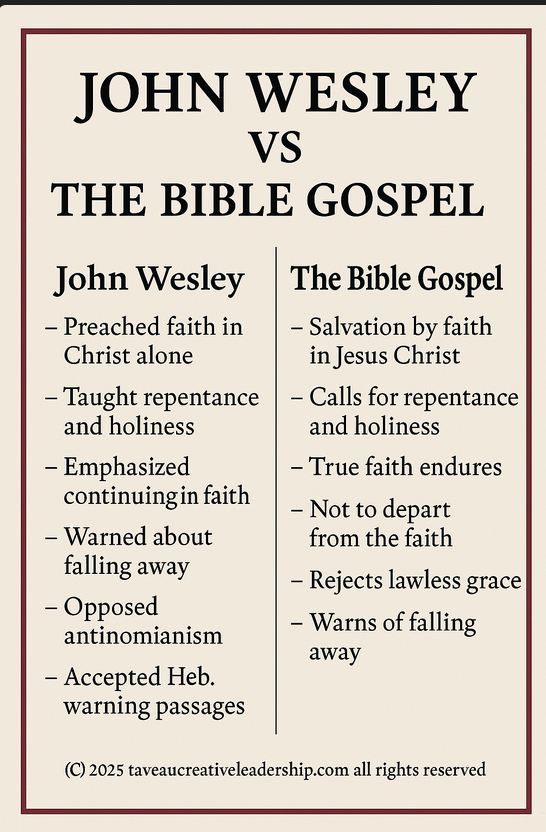
Wesley preached:
Salvation by grace through faith
Christ alone saves
Repentance
New birth
Holiness of heart and life
Continuing in faith
Warnings against willful sin
Warnings against falling away
Scripture as final authority
No lawless grace
No “sin doesn’t matter” doctrine
No works-based righteousness
Assurance through the Spirit
No “once saved always saved”
Acts-style discipleship
He never preached:
psychology as gospel
cultural accommodation
human tradition
self-esteem gospel
moral niceness without repentance
SECTION 4 — DID WESLEY PREACH A TRUE OR ACCURSED GOSPEL?
✔ Wesley vs Jesus — MATCH
Repentance, new birth, abiding, holiness.
✔ Wesley vs Paul — MATCH
Grace through faith, Christ alone, holiness, continuance.
✔ Wesley vs Hebrews — MATCH
Warnings about falling away, willful sin, endurance.
✔ Wesley vs Acts — MATCH
Repent, believe, be born again, live holy, continue steadfastly.
FINAL VERDICT
Methodist founder, trailblazer, organic Pioneer John Wesley preached a TRUE Gospel — not an accursed one.
His doctrine matches Jesus, Paul, Hebrews, and Acts.
The accursed gospels today come from those who have left Scripture — not from Wesley.
Extremely Important
DID JOHN WESLEY BELIEVE “ONCE SAVED ALWAYS SAVED”?
Short Answer
No.
John Wesley explicitly rejected the doctrine now called “once saved always saved” (OSAS) or “eternal security.”
He was a strong Arminian (not Calvinist..”Predestination”). Arminianism taught that a genuinely saved person could fall from grace through persistent unbelief or deliberate, willful sin.
He believed:
Salvation is secure as long as a believer continues in living faith.
But salvation is not unconditionally guaranteed regardless of later conduct.
This aligns him more with Paul’s warnings (1 Cor 9:27; Gal 5:4; Heb 6:4–6; Heb 10:26–29) than with later Reformed theology.
WHAT WAS WESLEY’S REASONING?
Wesley based his belief on three pillars:
1. Scripture teaches real warnings
He held that God does not threaten impossible conditions.
He quoted:
-
Ezekiel 18:24 – “If the righteous turn from his righteousness…”
-
Galatians 5:4 – “Ye are fallen from grace.”
-
Hebrews 6:4–6 – those who “fall away”
-
Hebrews 10:26–31 – “no more sacrifice for sins” after willful sin
-
1 Corinthians 9:27 – Paul feared becoming a “castaway”
He concluded:
“The possibility of falling from grace is spoken in too many Scriptures to be denied.”
2. Salvation begins with faith — and can be destroyed by unbelief
Wesley taught:
-
Salvation = living faith + God’s grace
-
Faith is the hand that holds salvation
-
If faith is destroyed, salvation cannot be retained
He preached:
“A true believer may, through the cunning of the enemy, make shipwreck of faith.”
(Referencing 1 Timothy 1:19)
3. Salvation is relational, not mechanical
He emphasized:
“Salvation is not a moment—it is a relationship.”
A living relationship can be:
-
ignored
-
neglected
-
rejected
-
hardened
-
abandoned
He believed God will not force a person to remain in grace if the person decisively rejects Christ by heart, life, or will.
TO BE CONTINUED
TO SUPPORT:
(C)2025 Taveau D’Arcy All copyrights reserved in conjunction with AI