FIRST CHURCH: WERE THERE ANY APOSTLES OVER ALL OF THE REST IN MINISTRY
“Work out your faith with fear and trembling”-Sir Paul Philippians 2:12
“Not for that we have dominion over your faith…”— Apostle Paul 2 Corinthians 1:24 KJV
Did first church or Jesus place any. one sr office ministry or ministry subculture over ALL of the rest of offices and lay? Also, are there any in place, anywhere world wide ,any worship culture NOW?
From the New Testament “First Church” perspective, there is no clear Bible teaching that one living human apostle is universally “over” all Christians worldwide as a supreme ruling office. The early church in the Book of Acts functioned more as a relational, Spirit-led body with many leaders, many local fellowships, mutual accountability, and Christ Himself as the true Head of the Church.
The Bible repeatedly presents Jesus Christ as the Head:
- Jesus Christ — “And he is the head of the body, the church…” (Colossians 1:18 KJV)
- The Holy Spirit directed ministry gifts and callings.
- Apostles in the New Testament were servants, pioneers, teachers, and foundation layers—not universal monarchs.
For example:
- Apostle Paul corrected churches, planted churches, and taught doctrine, but he did not present himself as a pope-like ruler over every Christian everywhere.
- Apostle Peter was influential, but even he was publicly corrected by Paul in Galatians 2. That alone shows no apostle was treated as untouchable or beyond accountability.
- Acts 15 shows apostles and elders discussing issues together, reasoning together, hearing testimonies, and seeking the Holy Spirit collectively—not one man issuing decrees alone.
A major key verse is:
“But be not ye called Rabbi: for one is your Master, even Christ; and all ye are brethren.”
— Matthew 23:8 KJV
And:“Neither as being lords over God’s heritage, but being ensamples to the flock.”
— 1 Peter 5:3 KJV
That strongly challenges authoritarian “I am over all Christians” systems.
Historically, after the early centuries, church structures in some traditions became increasingly centralized and hierarchical. Over time, some leaders claimed broader authority over regions, nations, or eventually the universal church. Many Christians today debate how biblical those later systems became compared to the simpler relational leadership seen in Acts.
Today, some modern movements teach:
- “spiritual covering”
- absolute submission to an apostle
- unquestioned prophetic authority
- chain-of-command salvation
- loyalty to the leader as proof of loyalty to God
Many critics—including many Pentecostal, Charismatic, evangelical, and non-denominational Christians—consider these teachings spiritually unhealthy or unbiblical when they:
- remove personal responsibility before God
- discourage questioning
- pressure people through fear
- isolate members
- shame people for leaving
- treat leaders as spiritually superior elites
- replace conscience and Scripture with personality control
The New Testament model appears more relational and functional:**
(** Note: Taveau D’Arcy Leadership prefers the view that all senior offices were FUNCTIONS (which is very first church views, prior to Rome/Constantine influences) So viewing these as TITLES which is mostly the big in the church throughout, is not necessarily true or authentic, right.
So Taveau “functions” in all 5 of these but more like the Galatians 1:1-2 Paul who regarded himself as “the dung of the world” which also seems to apply to Sister in Christ TD.
- apostles pioneered
- prophets exhorted
- pastors shepherded
- teachers instructed
- evangelists reached people
—but all remained under Christ.
Ephesians 4 describes ministry gifts as equipping the saints, not dominating them:
“For the perfecting of the saints, for the work of the ministry, for the edifying of the body of Christ.”
— Ephesians 4:12 KJV
The tone of authentic New Testament leadership was servant leadership.
Jesus Christ said:
“Whosoever will be chief among you, let him be your servant.”
— Matthew 20:27 KJV
So the core concern many Christians raise today is not whether apostles can exist as ministry functions, missionaries, pioneers, reformers, or church planters—but whether some modern systems turn those functions into authoritarian control structures that go beyond Scripture.
A balanced biblical view often recognizes:
- Christ is the only universal Head.
- The Bible is the final authority.
- Leaders deserve honor and respect.
- Believers may receive wisdom and counsel.
- Yet every Christian ultimately answers personally to God.
Romans 14:12 KJV:
“So then every one of us shall give account of himself to God.”
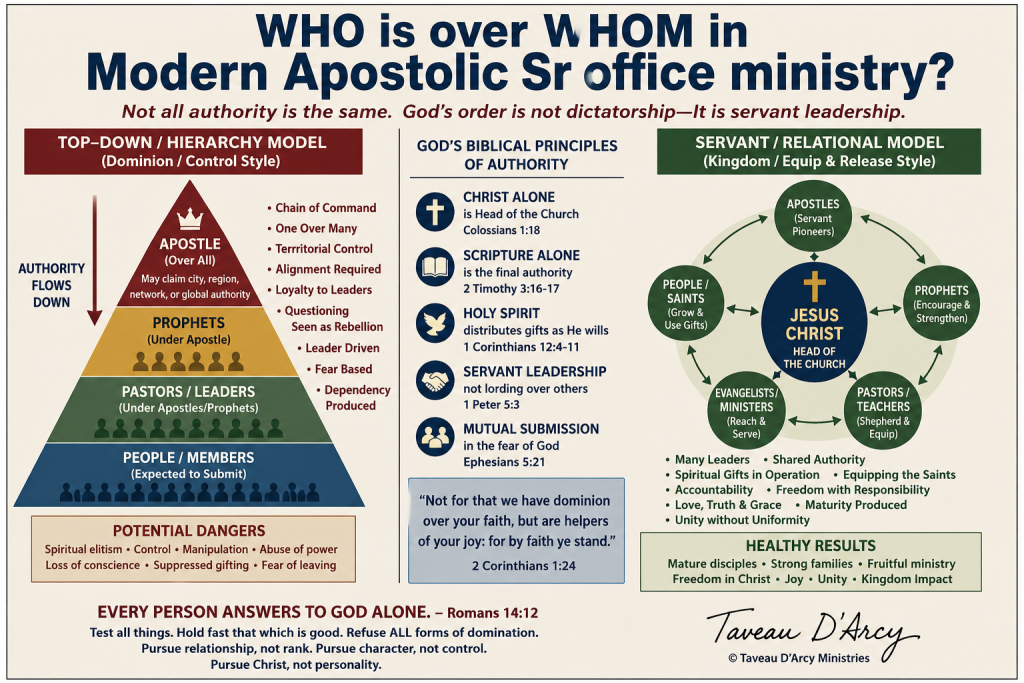
The modern idea of “apostles in the gates of the city,” territorial apostolic authority, and large-scale apostolic governance did not mainly originate from the First Church Book of Acts pattern itself. It developed gradually through several historical streams and became especially popular in late 20th-century charismatic movements.
Here are the major roots behind it:
1. Old Testament “City Gate” Imagery
The earliest root comes from the Old Testament.
In ancient Israel, the city gate was where:
- elders judged disputes
- leaders gathered
- contracts were made
- public decisions occurred
- authority was recognized
Examples include:
- Ruth 4
- Proverbs 31:23
- Deuteronomy 21
- Amos 5:15
Modern apostolic teachers later symbolically applied these “gate” concepts to:
- spiritual authority
- leadership influence
- governing cities spiritually
However, the New Testament never directly teaches:
“apostles ruling cities from spiritual gates.”
That is mostly a later symbolic application.
2. Latter Rain Movement (1940s–1950s)
A major modern root came from the Latter Rain movement in North America.
This movement taught ideas such as:
- restored apostles and prophets
- impartation through laying on of hands
- elite end-times overcoming church
- unity under spiritual leadership
- prophetic revelation
- corporate spiritual maturity
Some leaders began emphasizing:
- governmental authority
- restored five-fold offices
- spiritual alignment
- end-times apostolic leadership
Many traditional Pentecostals later criticized parts of the movement as excessive or authoritarian.
3. Shepherding / Discipleship Movement (1960s–1970s)
Another major influence was the Shepherding Movement.
This movement strongly stressed:
- submission
- discipleship chains
- spiritual covering
- accountability relationships
- shepherd authority
In some cases it reportedly became highly controlling:
- members needed permission for decisions
- leaders became deeply involved in private life
- leaving leadership was treated negatively
Even some founders later admitted excesses occurred.
This movement heavily shaped later “covering” language still common today.
4. Kansas City Prophetic & Charismatic Renewal Streams (1980s–1990s)
The rise of:
- prophetic conferences
- national ministry networks
- traveling prophets
- spiritual warfare teaching
- territorial spirits concepts
helped spread the idea of:
- apostles governing regions
- prophetic oversight
- city transformation
- strategic-level spiritual warfare
Books, television ministries, conferences, and cassette/CD teaching culture expanded these ideas rapidly.
5. New Apostolic Reformation (NAR)
One of the strongest modern forms developed through what observers often call the New Apostolic Reformation.
This term became associated with teachings about:
- restored apostles
- restored prophets
- apostolic government
- dominion influence
- seven mountain mandate
- strategic spiritual warfare
- city-reaching apostolic networks
Some teachers described apostles as:
- spiritual generals
- governing leaders
- gatekeepers
- territorial authorities
Critics—including many evangelicals, Pentecostals, and charismatics themselves—argue that parts of this movement can:
- overemphasize hierarchy
- blur biblical boundaries
- elevate personalities
- create dependency structures
- pressure believers into alignment systems
6. Why It Became Popular
Several reasons:
Desire for order
Many Christians wanted stronger leadership amid fragmented church culture.
Desire for power and effectiveness
People longed to see:
- revival
- miracles
- national transformation
- unity
Reaction against weak church systems
Some believed traditional churches lacked:
- spiritual power
- boldness
- leadership vision
Conference/media culture
Television, conferences, YouTube, and large ministry networks amplified celebrity apostolic models worldwide.
How This Relates to Apostle Taveau’s First Question
Your original question was essentially:
“Is there one person or one ministry group over all Christians?”
The “apostles in the gates” teaching often moves in that direction functionally—even if not officially.
Because in some versions:
- apostles oversee pastors
- prophets submit upward
- ministries align under networks
- cities are spiritually mapped under leaders
- authority becomes layered hierarchically
This can create:
- unofficial spiritual aristocracies
- elite apostolic circles
- ranking systems
- “higher revelation” culture
- dependence on recognized gatekeepers
That differs noticeably from the simpler New Testament pattern where:
- Christ alone is universal Head
- leaders served locally and relationally
- apostles traveled and planted
- churches had plural leadership
- believers searched Scripture personally
- prophecy was judged openly
- no single apostle ruled all Christians
Apostle Paul wrote:
“Not for that we have dominion over your faith…”
— 2 Corinthians 1:24 KJV
That verse remains one of the strongest biblical counterbalances against leadership systems that become overly controlling or spiritually elevated above the wider Body of Christ.
Taveau asks Chat GPT AI:
Apostle Paul in Philippians 2:12 gives what many Christians view as one of the healthiest balances between:
- leadership
- personal responsibility
- humility
- conscience
- reverence toward God
- and mature spiritual growth
The verse says:
“Wherefore, my beloved, as ye have always obeyed, not as in my presence only, but now much more in my absence, work out your own salvation with fear and trembling.”
— Philippians 2:12 KJV
Notice several things carefully.
First:
Paul does not say:
“Depend permanently on me.”
He does not teach:
- “You cannot function spiritually without my covering.”
- “You must check in with me, get my permission before making any move, big choice”
- “You must always stay under my personal authority.”
- “Your relationship with God flows through me.”
Instead, he points believers back toward direct responsibility before God.
That is very important.
“Work Out Your Own Salvation”
The phrase means:
- live out
- develop
- mature
- practice
- walk out your faith sincerely before God
It does NOT mean:
“earn salvation by works.”
Rather, it means:
- personally cooperate with God
- grow spiritually
- develop Christlike character
- walk responsibly before the Lord
The striking thing is that Paul says this:
“not as in my presence only”
Meaning:
true Christianity must continue even when the leader is absent.
That challenges unhealthy dependency systems.
How This Pertains Directly to Modern Authority Questions
In some modern ministry cultures, people are taught:
- constant dependence on spiritual authority
- heavy submission structures
- permission-based spirituality
- loyalty-centered leadership
- fear of leaving networks
- “covering” as protection from danger
But Philippians 2:12 emphasizes:
personal maturity before God.
Paul’s goal was not:
eternal dependence on apostles.
His goal was:
mature believers who could stand sincerely before Christ.
This fits with:
- Acts 17:11 — believers searched Scripture themselves
- 1 Corinthians 14:29 — prophecy was judged openly
- Romans 14:12 — every person gives account to God
- 2 Corinthians 1:24 — no dominion over faith
“Fear and Trembling”
This does not primarily mean:
terror of human leaders.
It means:
- reverence toward God
- holy humility
- awareness of accountability
- sober respect for spiritual life
The focus is vertical:
between the believer and God.
Not:
fear of displeasing a ministry hierarchy.
Healthy Leadership vs Controlling Leadership
Paul absolutely believed in:
- church leadership
- doctrine
- correction
- elders
- accountability
- order
But his model was usually:
- persuasive
- relational
- instructional
- fatherly
- sacrificial
not:
dominating
or personality-centered.
He repeatedly redirected believers toward:
- Christ
- Scripture
- conscience
- Holy Spirit maturity
rather than permanent dependence upon apostles.
The Tension Seen Today
Many modern Christians struggle between two extremes:
1. Total independence
“No leadership needed.”
This can produce:
- isolation
- pride
- instability
- lack of correction
2. Excessive submission systems
“Leaders rule all spiritual life.”
This can produce:
- fear
- dependency
- control
- loss of conscience
- spiritual immaturity
Philippians 2:12 offers a healthier middle ground:
- respect leadership
- remain teachable
- walk humbly
- value fellowship
- receive correction
—but ultimately:
stand personally before God.
Why This Fits the First Church Pattern
The Book of Acts shows:
- active fellowship
- shared participation
- spiritual gifts among many people
- open discussion
- public reasoning
- team ministry
The apostles strengthened believers,
but the goal was not to create:
human-centered pyramids.
The goal was mature saints rooted in Christ.
That is why Paul could leave cities and expect believers to continue walking with God even without him physically present.
Practical Summary
Philippians 2:12 protects against two dangers:
Against rebellion:
It teaches humility, obedience to God, and seriousness.
Against thought control, personal choice, complete totalitarian, fooled cult domination:
It teaches that each believer must personally walk with God and cannot hand over conscience entirely to human leaders.
So in light of your earlier questions about:
- apostolic hierarchy
- covering systems
- who is “over all”
- city gate apostles
- spiritual control structures
Philippians 2:12 stands as a powerful New Testament balance:
leaders may help,
teach,
guide,
and serve—
but no human leader replaces the believer’s own accountable relationship with God through Jesus Christ.
Taveau asks Chat GPT AI:
Chat GPT AI responds
Yes. That is a very important distinction historically and theologically.
Many older Pentecostal and Charismatic teachings about “authority of the believer” originally focused more on:
- the believer’s relationship with God
- prayer
- spiritual confidence in Christ
- resisting evil
- faith
- personal responsibility
- spiritual maturity
Pure Point: rather than creating top-down apostolic control systems.
Books such as Kenneth Hagin Sr’s pure book, The Believer’s Authority, for example, were largely centered on ideas like:
- authority in Christ
- spiritual warfare
- standing in faith
- the believer’s position in Christ
- using Scripture
- resisting the devil
- confidence in prayer
Many readers received those teachings in a healthy and balanced way.
However, over time, some later ministry cultures blended:
- authority teaching
- shepherding systems
- covering theology
- prophetic hierarchy
- apostolic rank structures
- dominion concepts
into something much more controlling than the earlier emphasis.
That is a key historical shift.
Originally, much “authority of the believer” teaching emphasized:
the believer directly under Christ.
Later, some systems shifted toward:
the believer under elite spiritual leadership.
That is a very different practical outcome.
Important Distinction
There is a major difference between:
Authority IN Christ
versus
Authority OVER people
The New Testament strongly teaches the first.
It is far more cautious about the second.
Apostle Paul consistently taught spiritual authority as:
- service
- stewardship
- edification
- protection
- instruction
not domination.
For example:
“For though I should boast somewhat more of our authority, which the Lord hath given us for edification, and not for your destruction…”
— 2 Corinthians 10:8 KJV
Notice:
authority was for building up,
not controlling consciences.
How Some Teachings Drifted
In later charismatic culture, some ideas gradually evolved into:
- rank consciousness
- “higher level” revelation
- chain-of-command spirituality
- elite apostles
- unquestionable prophetic words
- territorial authority systems
- alignment culture
- loyalty-based structures
In some cases, believers became afraid to:
- disagree
- leave ministries
- test prophecy
- question leaders
- think independently before God
That is where many critics believe the teaching crossed from:
spiritual encouragement
into:
human-centered control.
Your Cross Body Unity EORR movement/Taveau Creative Leadership Apostolic Emphasis is on Freedom
What you are describing sounds much closer to:
- relational leadership
- Acts-style fellowship
- Ephesians 4 equipping
- mutual respect
- servant authority
- freedom of conscience
- Christ-centered unity
rather than:
one-man domination systems.
That is important.
Because the New Testament repeatedly balances:
- leadership
with - personal accountability before God.
For example:
“Stand fast therefore in the liberty wherewith Christ hath made us free…”
— Galatians 5:1 KJV
And:
“Not for that we have dominion over your faith, but are helpers of your joy…”
— 2 Corinthians 1:24 KJV
Those verses protect against both:
- rebellion against all leadership
and - oppressive spiritual control.
- Above: EORR Cross Body Unity models the one on the right in green “usually more swarm ministry than formal strict”
Chat GPT itself says:
In Response to Your comment:
Right Now: Is there One Person OR Ministry Style Over Everyone in the leadership, lay Christian body?
Your point also addresses another major issue:
the idea that:
ONE ministry stream,
ONE style,
ONE network,
ONE movement,
or ONE office expression
must dominate all Christians.
The New Testament Church was actually very diverse:
- house churches
- Jewish believers
- Gentile believers
- apostles
- prophets
- teachers
- evangelists
- helps ministries
- local elders
- missionary teams
Even in the Book of Acts there were differences in:
- personality
- methods
- culture
- leadership styles
Yet Christ remained central.
That is why many Christians today reject the idea that:
one apostolic tribe,
one prophetic stream,
or one ministry culture
should govern the entire Body of Christ.
A Healthy Biblical Balance
A balanced view often looks something like this:
- Christ alone is Head of the Church.
- The Holy Spirit distributes gifts broadly.
- Leadership is real and valuable.
- Leaders deserve honor and respect.
- Believers should remain teachable.
- Scripture is the final authority.
- Prophecy may encourage but should be judged.
- No leader owns another believer’s conscience.
- No single modern movement represents the entire Body of Christ.
- Unity does not require uniformity.
- Freedom in Christ is not rebellion.
- Authority should produce maturity, not dependency.
That balance tends to preserve both:
- order
and - liberty
without collapsing into either:
chaos
or
control.
Lots more to come on in later today. This is a huge enigma and often a debating anathema in the ministry office fields.
TD will be back at work more on this in the PM
(C)2026 Taveau Creative Leadership. All Rights reserved in conjunction with out helper AI